Can AI Grade Engineering Drawings as Well as a Human?
A new study compares AI-generated grades on technical drawings with human results. The outcome: no statistically significant difference.
Can AI grade engineering drawings as well as a human? A new study says: statistically, yes.
Javier Munguia compared AI-generated grades on 2D technical drawings from students with historical human grading results. The outcome: no statistically significant difference between AI and human scores on the dataset.
Not perfect — but close enough
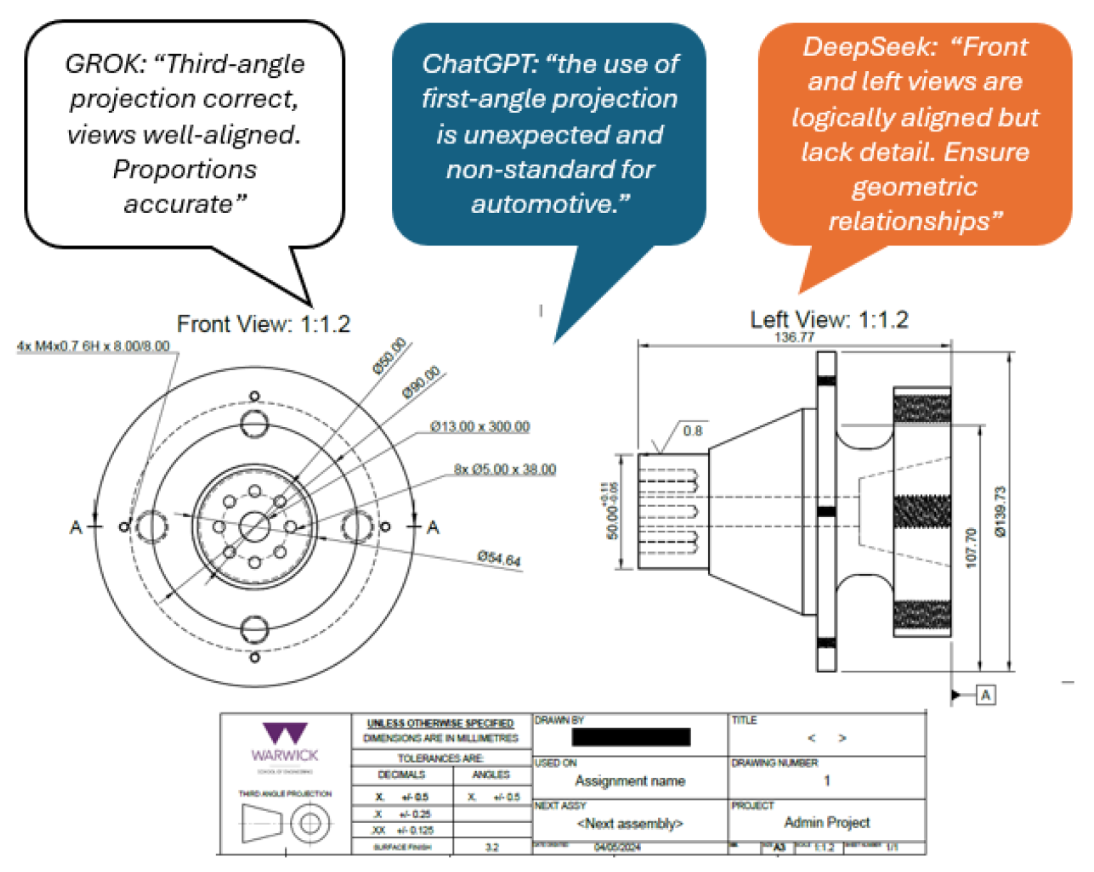
The authors note some typical AI mistakes. For example, it misidentified the projection type, as shown in the image below. And there was a slight bias toward grade inflation. So it’s not “perfect alignment.” But the gaps weren’t large enough to reach statistical significance.
What I found interesting
A few details stood out to me:
- The study was conducted half a year ago — and not even on the strongest models available back then.
- The best results came from giving the model feedback on five graded drawings before letting it evaluate independently.
- The author published the full set of 32 drawings used in the study — great for reproducibility, or just experimenting with the data yourself.
What this means
For me, this reinforces that AI models have crossed the threshold of being practically useful for technical drawing analysis.
These results were achieved with GPT-4-turbo (and an old Grok model). New models have gotten even more capable. For us, moving from GPT-4 to GPT-5.2 made a strong difference for image-based analysis.
It feels like we’re moving from “interesting experiment” to something that should become part of engineering workflows.
Links
